Vulnerability Assessment vs Penetration Testing Explained
Vulnerability assessment vs penetration testing: learn what each finds, what each costs in Canada, and when to use one, the other, or both.

Vulnerability assessment vs penetration testing: learn what each finds, what each costs in Canada, and when to use one, the other, or both.

A vendor questionnaire lands in your inbox asking for both a vulnerability assessment and a penetration test. Your IT team already runs scans, but the office manager needs to know whether those reports satisfy both requests, and whether another security engagement will leave anyone time to fix the findings.
The practical answer to vulnerability assessment vs penetration testing isn't to pick a winner. It's to sequence discovery, remediation and controlled attack testing around how quickly your environment changes and how much work your team can complete.
Say a mid-sized clinic needs to demonstrate that its patient-facing application and internal systems have been assessed. A scanner's findings can help identify missing patches, but they don't necessarily demonstrate whether an attacker could reach patient information.
Vulnerability assessment and penetration test compared
| Criterion | Vulnerability assessment | Penetration test |
|---|---|---|
| Core question | What weaknesses are present and how should they be prioritized? | Can an attacker exploit these weaknesses, and what could they reach? |
| Method | Automated scanning across applications and infrastructure, with analyst validation | Expert-led simulation of adversary actions under agreed rules of engagement |
| Main output | Prioritized list of known weaknesses with remediation owners | Demonstrated attack paths, evidence of exploitation and impact assessment |
| Measure of success | Coverage, repeatability and risk ranking | Exploitability and the depth of access achieved within defined limits |
| Typical cadence | Recurring or triggered by newly disclosed vulnerabilities | Scoped, usually annual or triggered by major change |
| Best fit | Building and maintaining a baseline of exposure | Validating controls that scanners cannot model |
A vulnerability assessment shows where weaknesses exist and how to rank them; a penetration test shows whether an attacker can use them. They're complementary, not rivals.
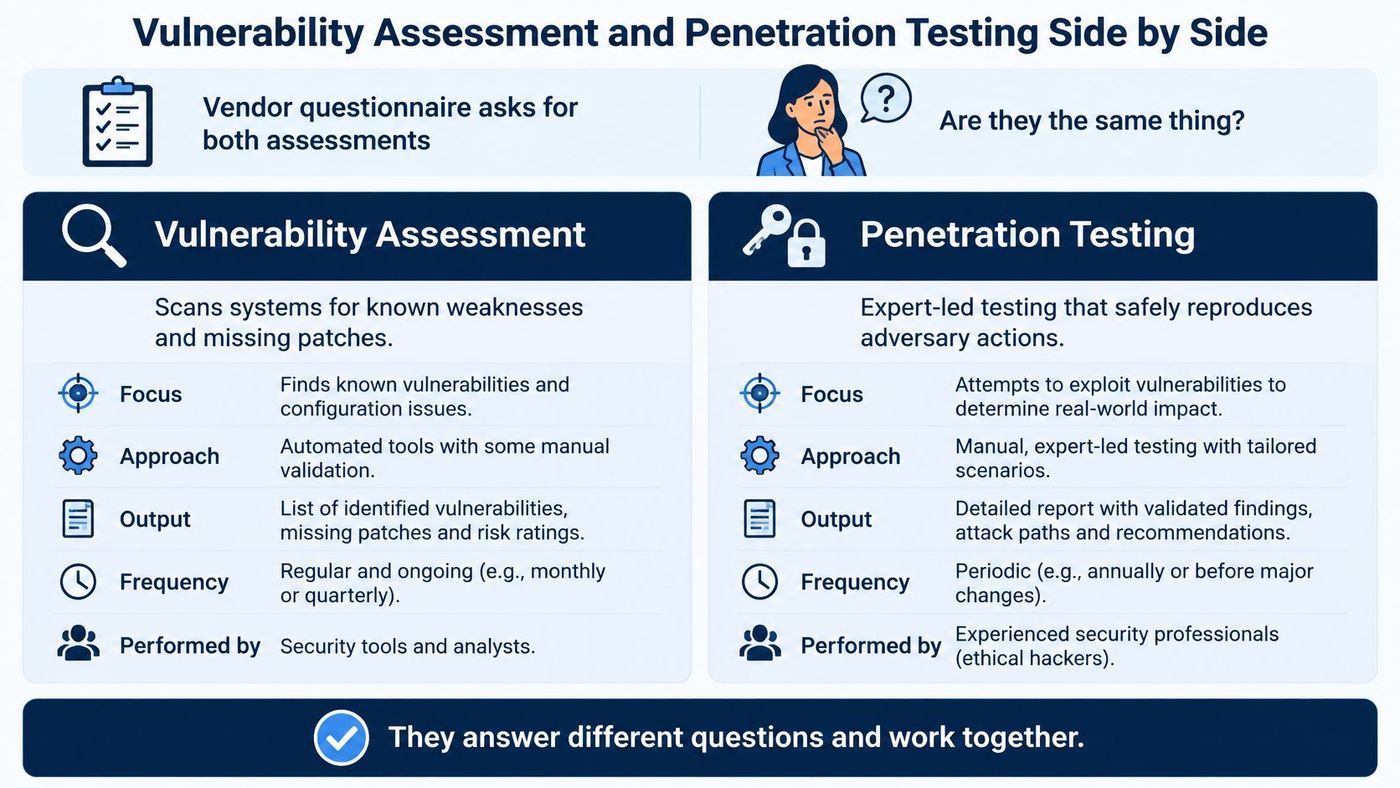
An assessment report should be usable as a work queue. Look for affected assets, validated findings, business priorities and named remediation owners, rather than an unfiltered scanner export.
A penetration-test report should explain the tester's route through the environment, the access obtained and the evidence supporting each conclusion. The Government of Canada's assessment guidance distinguishes this specialised testing from automated scanning and describes its role in validating suspected vulnerabilities under defined constraints.
For a broader review of policies, access and controls, MD TECH TEAM's guide can help you check if your setup is secure. Keep that broader audit conversation separate from the technical deliverables you're purchasing.
If you don't yet know everything you own, start with an assessment and a documented vulnerability assessment methodology. If your inventory is reliable and you need evidence about a particular breach scenario, scope a test around that scenario.
Canadian incident figures make the case for combining broad discovery with deeper validation. The Canadian Centre for Cyber Security's National Cyber Threat Assessment reports that ransomware incidents affecting Canadian organizations increased by an average of 26% per year from 2021 through 2024, with sector increases between 2022 and 2023 of 159% in information technology, 157% in finance, 133% in construction, 122% in transportation, 112% in professional services, 75% in healthcare and 67% in energy.
Those are historical observations, not a prediction of your organization's likelihood of compromise. They do show why an IT manager shouldn't treat a completed security questionnaire as evidence that the environment can withstand an attack.
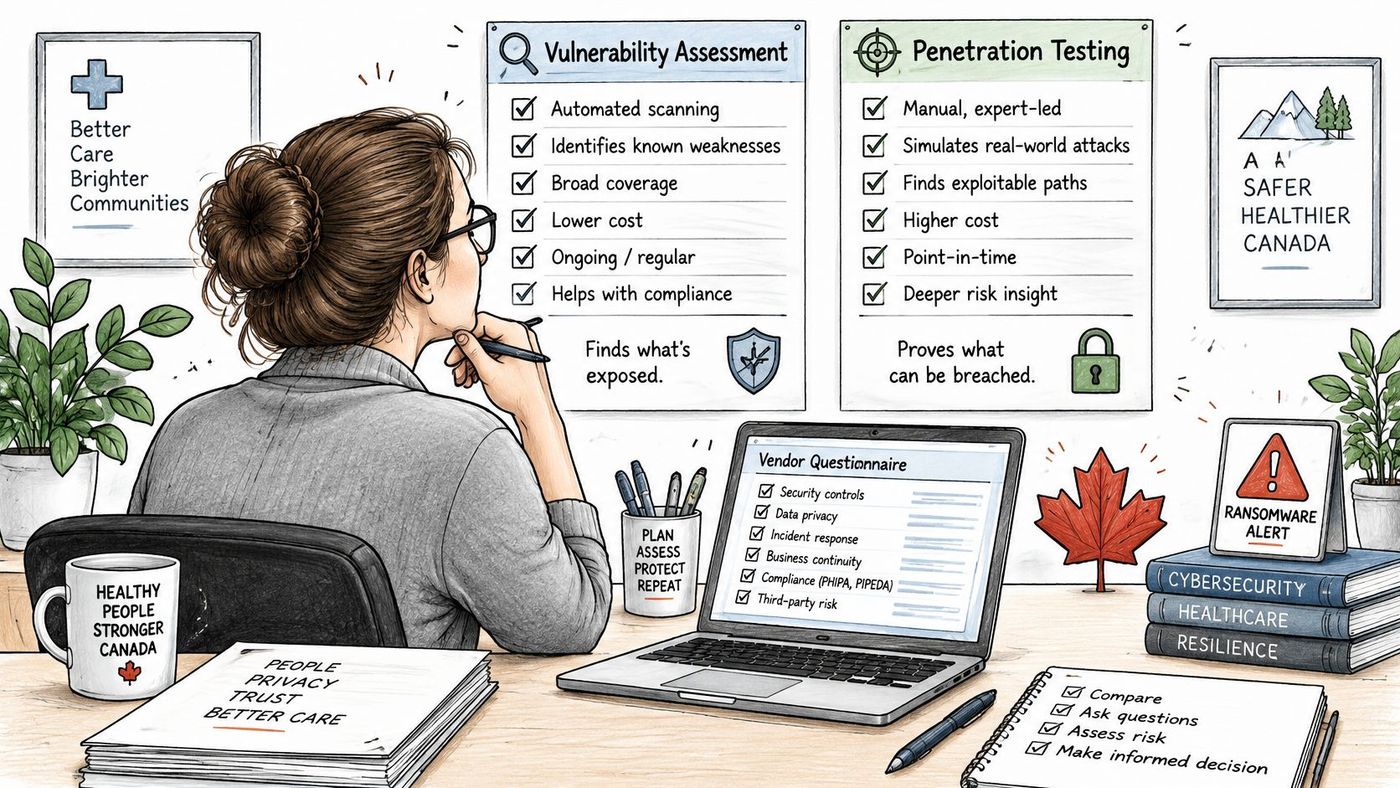
The Cyber Centre's ransomware playbook places penetration testing within a broader vulnerability-assessment programme and cites the 2023 Canadian Survey of Cyber Security and Cybercrime, which covered more than 12,000 organizations and found that incident recovery costs doubled to approximately CAD 1.2 billion in 2023.
For a medium-sized business, that layered approach means assigning distinct responsibilities:
Consider a manufacturer with an internet-facing remote-access service and an internal production network. Finding an outdated service matters, but management also needs to understand whether someone entering through that service could reach production systems.
Practical rule: Give leadership evidence of both the weaknesses your team is managing and the attack scenarios your controls have resisted.
Record those decisions within a compliance risk management framework. Technical findings become more useful when a business owner accepts the remaining risk, approves corrective work or changes how a critical service operates.
Frequency should follow risk, not an assumed national deadline. The Cyber Centre's risk-assessment guidance recommends scanning systems and hosted applications at an organization-defined frequency, or randomly under a documented process, and when newly reported vulnerabilities could affect them.
That leaves you responsible for setting a workable schedule. Internet exposure, sensitive information, change frequency and operational constraints should influence it.
Trigger-based cadence for assessments and tests
| Trigger | Action to take | Activity |
|---|---|---|
| Routine schedule set by risk | Scan at a defined frequency and rank findings | Vulnerability assessment |
| New vulnerability disclosed that affects your systems | Scan affected assets and prioritize remediation | Vulnerability assessment |
| Major change to network, cloud, identity or applications | Rescan, then scope a targeted test | Both |
| Annual or risk-triggered review | Test controls that scanners cannot model | Penetration test |
| Before acquisition or high-impact launch | Test once known exposure has been reduced | Penetration test |
For a changing Microsoft 365 environment, distinguish configuration review from network scanning. A scanner aimed at internet-facing hosts won't necessarily evaluate tenant permissions, conditional access or application consent; include the appropriate assessment methods in scope.
Put assessment triggers into change tickets. A firewall replacement, cloud migration or identity redesign should include an explicit decision about rescanning and targeted validation, rather than relying on someone to remember later.
The Cyber Centre's ITSG-33 guidance treats vulnerability analysis as an input to penetration testing. Make that handoff useful by recording:
Your vulnerability management process should connect those records to the team's patching and change workflows. Don't increase scanning frequency just to generate more unresolved tickets.
A one-time assessment may satisfy a document request. A scheduled, triggered programme with accountable remediation is security practice.
The meaningful result isn't the number of findings. It's the evidence of what a tester could achieve within the agreed boundaries. A long report can be less useful than a clearly demonstrated route to a sensitive application.
The Canadian Centre for Cyber Security's assessment, authorization and monitoring guidance describes penetration testing as expert-led work beyond automated scanning, evaluating resistance within defined limits of time, resources and skill. Its assessment model supports testing external or internal networks, applications, hardware, firmware, and physical or technical controls.
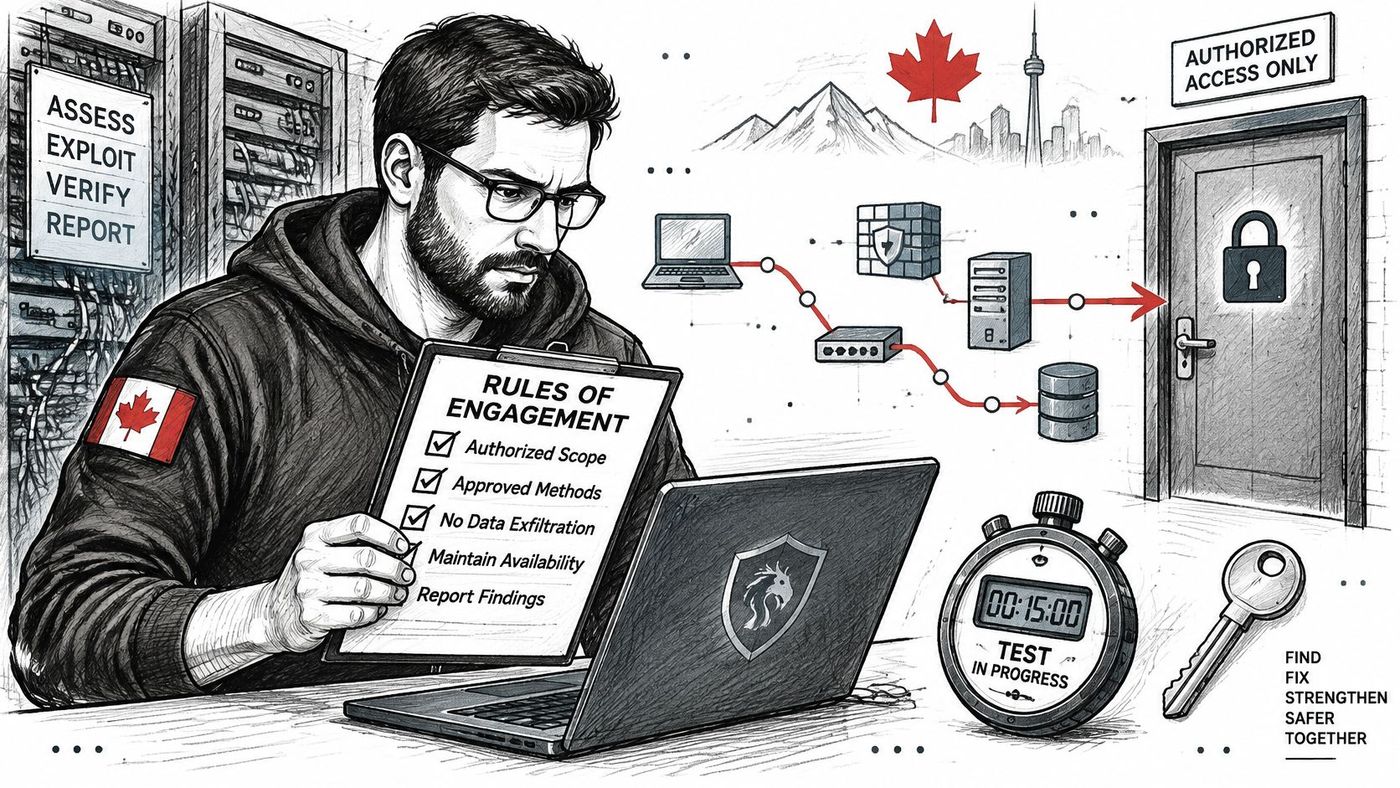
Say a tester obtains access to a low-privilege account. The valuable question isn't merely whether the login worked, but whether that account can access an administrative interface or confidential records it shouldn't reach.
An unsuccessful attack attempt also needs context. A blocked technique, an unavailable service and an expired testing window are different outcomes; the report shouldn't present them as equivalent evidence of resistance.
Canadian readiness guidance also supports regular third-party validation, including external-compromise and assume-breach lateral-movement scenarios, with operational technology considerations for industrial environments. An assume-breach exercise starts from agreed internal access, so it tests containment rather than only the perimeter.
Require written rules covering:
A test that didn't reach a system hasn't necessarily proved that system secure. Its conclusions must stay within what the testers actually examined.
A 2026 Canadian provider estimate from Sincennes places vulnerability assessments at CAD 2,500 to 5,000, compared with CAD 5,000 to 12,000 for a focused external network penetration test. Treat these as published budgeting references, not a Canadian market average or a quote for your environment.
Typical Canadian cost ranges for each activity
| Service | Typical cost (CAD) | Basis |
|---|---|---|
| Vulnerability assessment | 2,500 to 5,000 | Canadian provider estimate, 2026 |
| Focused external network penetration test | 5,000 to 12,000 | Canadian provider estimate, 2026 |
Price follows scope, and scope varies more between proposals than the headline figure suggests. An external-only test of a handful of internet-facing hosts sits at the low end of the range; add internal network access, authenticated scanning or application testing and the engagement grows. The external-test range isn't a reliable proxy for internal or combined work, so a proposal needs to state its boundaries before you can compare it against anything else.
These scope decisions should be explicit in a proposal:
An inexpensive proposal may exclude authenticated assessment, application testing or remediation verification. That isn't automatically poor value, but it answers a narrower question than your procurement team expects.
Budget recurring assessments as an operating expense tied to your schedule. Treat penetration testing as a scoped project that needs repricing when the environment or objective changes; the penetration-testing cost guide can help structure that budgeting conversation.
Budget judgement: I would fund remediation capacity before expanding a test merely to produce a larger report.
CloudOrbis offers a free IT Risk Assessment as a starting point for identifying gaps and discussing scope. Don't assume that an introductory risk assessment is interchangeable with a commissioned technical vulnerability assessment or penetration test.
Before signing, confirm exclusions, access requirements, reporting expectations and retesting. A cheaper assessment whose findings get fixed can be more useful than an extensive engagement that leaves no budget for corrective work.
The choice is about timing, not which method is better. The Government of Canada's vulnerability-management guideline distinguishes regular vulnerability discovery and rescanning from the specialised work of determining whether weaknesses can be exploited.
For an organization with an incomplete inventory, unsupported software or frequent Microsoft 365, cloud and firewall changes, start by establishing a repeatable baseline. Paying testers to rediscover a backlog you already intend to fix can consume the budget you need to resolve it.
Starting point by organizational situation
| Situation | Start with | Then |
|---|---|---|
| Incomplete asset inventory or unsupported software | Vulnerability assessment | Penetration test once exposure drops |
| Frequent Microsoft 365, cloud or firewall changes | Recurring assessment with rescans | Targeted test after each major change |
| Acquisition, compliance review or high-impact launch | Vulnerability assessment to clear known gaps | Penetration test before go-live |
| Connected medical devices in a clinic | Vulnerability scans of device software and configuration | Penetration test against applicable Health Canada requirements |
| Mature program with reduced exposure | Penetration test to validate controls | Keep scanning for new issues |
A penetration test becomes more valuable when management needs to approve a consequential change. Before an acquisition, for example, define whether the concern is inherited internet exposure, connectivity between businesses or access to sensitive information.
Don't postpone all testing until every finding is closed. A focused test can be justified when you need to determine whether an unresolved weakness threatens an important system or whether a compensating control works.
For clinics, the Cyber Centre's connected-medical-device guidance recommends cybersecurity tests that include both vulnerability scans and penetration tests, based on Health Canada requirements, regulations and recommendations. Coordinate device testing with clinical operations and the manufacturer; don't treat a production medical device like an ordinary office endpoint.
Buying an annual penetration test while scan findings remain unpatched can create false assurance. The test demonstrates exploitability at a point in time, while administrators continue changing the environment.
Your remediation capacity should influence engagement size. If the team can't resolve the highest-priority backlog, narrow the next engagement to the decision that matters most rather than commissioning another broad report.
The business benefits of penetration testing become tangible when findings influence access design, segmentation and investment decisions.
Apply this rule: discover enough to prioritize, fix enough to make testing worthwhile, then validate the controls that protect your most important operations.
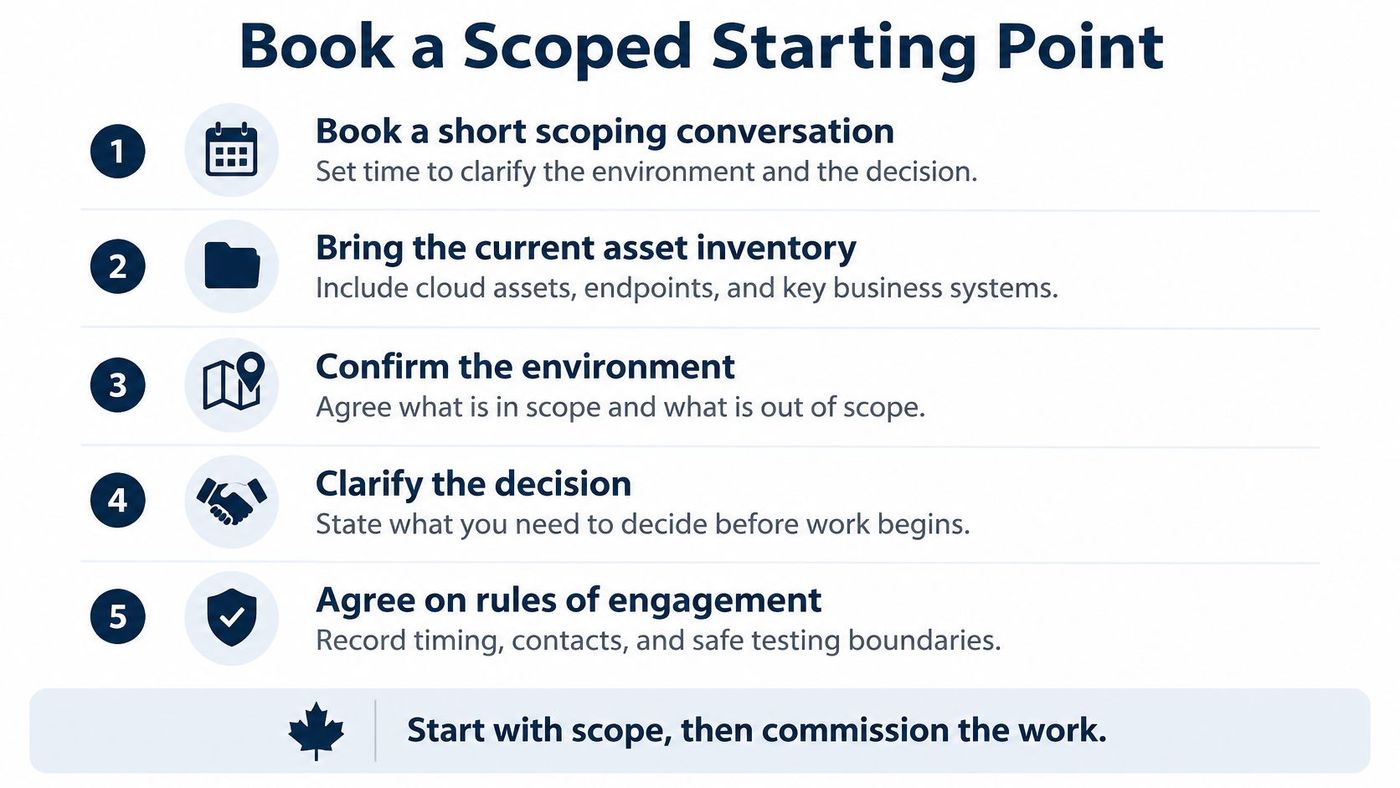
Commission work only after the environment and the decision are clear. A request to test everything invites mismatched proposals because each bidder may interpret everything differently.
Bring your current asset inventory, including cloud tenants, SaaS platforms, endpoints and critical business applications. Include the most recent scan or penetration-test report, even if it contains unresolved findings; the backlog helps distinguish new discovery work from remediation and validation.
Use a checklist to keep the discussion focused on scope and safe execution.
In Week 1 of our transition process, our Discovery & Audit maps the client's network and identifies risks without disrupting the team. Step 2, our Deep Dive Assessment, identifies structural weaknesses, undocumented systems and risk exposure.
Those activities help establish what needs attention before you commission technical work against an uncertain inventory. They don't remove the need to define a penetration test's authorization, targets and operating boundaries.
The useful outcome of the first conversation is a clear scope: assets included, exclusions, the question being tested, expected deliverables and what will be retested after fixes. Bring the asset list and latest report so the eventual quote reflects the actual environment rather than a rough description of it.
CloudOrbis Inc. offers a free IT Risk Assessment to help identify gaps and establish a practical starting point for vulnerability assessment and penetration testing. Visit CloudOrbis Inc. to book yours, and bring your asset inventory and most recent assessment report so we can discuss the right scope and sequence for your organization.
Book a 30-minute call with a senior engineer. No sales script, just straight answers about your environment.


