IT Consulting Near Me: Finding a Strategic Tech Partner in 2026
Find expert IT consulting near me. This guide connects Canadian businesses with local tech partners to drive growth, security, and strategic success in 2026.

Find expert IT consulting near me. This guide connects Canadian businesses with local tech partners to drive growth, security, and strategic success in 2026.
When you search for “IT consulting near me,” you’re not just looking for a tech vendor. You’re seeking a strategic partner who can give your business a genuine competitive edge. The right local consultant provides just that, blending rapid, on-site support with a deep understanding of your regional business environment.
When your network suddenly goes down, every minute of downtime feels like an hour. Having an IT partner around the corner, whether you’re in Toronto, Calgary, or Edmonton, means getting someone on-site quickly when a remote fix won’t cut it. That physical presence can be the difference between a minor hiccup and a full-blown, revenue-draining outage.

However, the advantages go well beyond faster response times. A local partner brings a unique mix of technical skill and regional knowledge that a national or offshore provider simply cannot replicate.
A Canadian firm understands our domestic market. They are already well-versed in navigating both federal and provincial regulations like the Personal Information Protection and Electronic Documents Act (PIPEDA). This knowledge is non-negotiable for protecting customer data and avoiding significant penalties.
Consider this: a healthcare clinic in Ontario needs a partner who not only resolves IT problems but also guarantees their systems comply with local health privacy laws. A manufacturing plant in Alberta needs a consultant who understands the specific operational and security pressures of the oil and gas sector. A local expert provides this context-aware guidance right from the start.
A truly local IT partner moves beyond helpdesk tickets. They invest time in understanding your business, your industry, and your specific challenges to provide personalized, proactive strategies that drive growth.
Perhaps the most significant benefit of a local IT consultant is their ability to become a true extension of your team. Proximity fosters a much deeper, more collaborative relationship. Your IT provider transitions from a reactive problem-solver to a proactive partner who spots opportunities for improvement.
They can perform on-site assessments, speak directly with your staff, and help build a technology roadmap that aligns perfectly with your long-term business goals. By exploring the different areas we serve, you can see how this localized support makes a tangible difference for businesses like yours.
This hands-on, strategic approach helps turn your IT from a necessary cost into a powerful asset that fuels innovation and efficiency. The end goal is to build a resilient, secure, and future-ready technology foundation that will support your organization’s growth for years to come.
Before searching for “IT consulting near me,” the most important work begins within your own organization. You will never find the right IT partner if you cannot clearly articulate what you need to solve.
Effective IT support isn’t about purchasing a bundle of services; it’s about solving genuine business problems.
Start by looking past the symptoms to find the root cause of your IT frustrations. Do employees consistently complain that the software is slow? That’s not just an “IT issue”, it’s a productivity drain that is quietly eating into your profits. Are you concerned about a potential data breach? That’s a direct threat to your company’s reputation and financial stability.
The key is to translate those general pains into specific, measurable needs. Instead of saying, “Our computers are slow,” you should document the actual business impact.
For example: “Our sales team loses 30 minutes per person, per day due to a lagging CRM. This delays quotes and negatively impacts our customer response times.” Notice the difference? You’ve reframed a technical problem as a business outcome.
One of the most effective ways to gain this clarity is to speak with your team. Gather feedback from every department to understand how technology either helps them perform their job or hinders their progress. You might be surprised to learn that a minor annoyance you have overlooked is a major roadblock for an entire team.
Don't just list symptoms like "slow Wi-Fi" or "frequent crashes." Instead, define the business outcome you want. For example, "We need a reliable network that supports seamless video conferencing for our hybrid team to improve collaboration and reduce meeting delays."
This self-assessment gives you a solid foundation for your search. When you can enter a conversation with a potential IT firm and present your specific challenges, you are in a position to find real solutions, not just a sales pitch.
For instance, a busy healthcare clinic in Ontario requires much more than basic IT help. Their core needs are likely:
Conversely, a growing manufacturing plant in Alberta would have a completely different set of priorities:
Once you have a firm grasp of your core problems, you can start matching them to specific IT services.
Consider what these common services actually mean for your business:
By defining what you need first, your search for an IT consultant becomes a strategic move. You are no longer just looking for a vendor, you are searching for a partner who understands your vision.
For a more structured approach, our ultimate IT checklist for Canadian small businesses can help ensure you have covered all your bases. This clarity allows you to ask the right questions and truly evaluate whether a provider is the right fit to help you grow.
You have done your homework and mapped out what your business needs from a technology standpoint. Now comes the challenging part: finding the right local IT partner to bring that vision to life.
It is tempting to simply search "IT consulting near me" and consider the job done, but that approach can lead to disappointment. To find a firm that will be genuinely invested in your success, not just another vendor, you need a more strategic approach.
This isn’t just about finding someone nearby; it's about finding someone qualified.
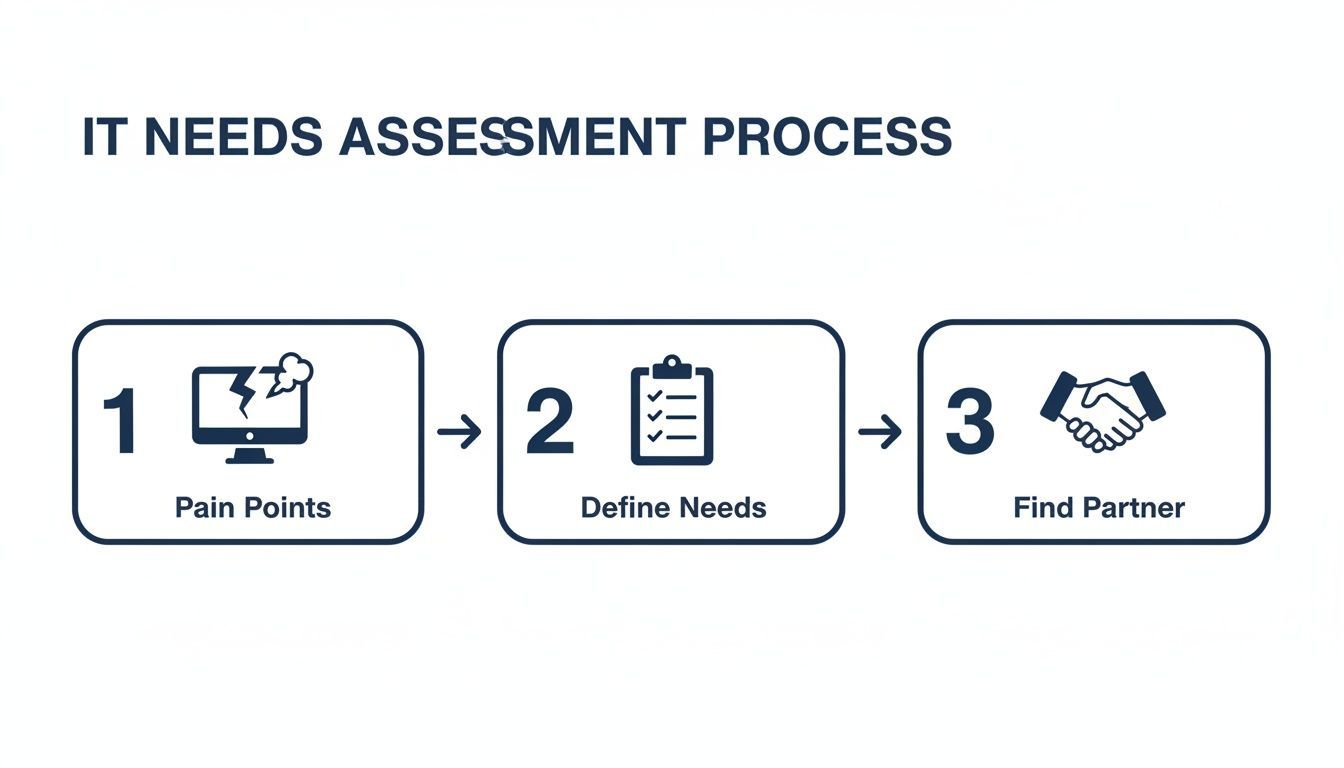
As you can see, identifying your pain points and defining your specific needs are the critical first steps. This groundwork allows you to have meaningful conversations with potential partners, steering clear of generic sales pitches and focusing on what truly matters: solving your business problems.
Start by being specific with your search. A law firm in Calgary, for instance, will find much better candidates by searching for ‘managed services for law firms in Calgary’ than a generic query. This simple adjustment helps filter out generalists and focus on providers with genuine industry expertise.
Next, look beyond search results and tap into your local community.
With a shortlist in hand, the real work begins. Your goal is to separate the proactive, strategic partners from the reactive, ‘break-fix’ technicians. A provider who only appears when something breaks is just a vendor; a true partner helps you prevent issues and plan for the future.
Before discussing services, use this quick checklist to evaluate potential firms from the start.
| Vetting Criteria | What to Look For (Green Flags) | Warning Signs (Red Flags) |
|---|---|---|
| Local Canadian Presence | A 100% Canada-based support team. They understand our regulatory environment (PIPEDA, provincial laws). | Support is outsourced overseas; unfamiliarity with Canadian business and compliance needs. |
| Industry Specialization | They have case studies or testimonials from businesses in your industry. They speak your language. | They offer a one-size-fits-all solution and have no experience in your specific sector. |
| Proactive vs. Reactive | They discuss strategic planning, vCIO services, and future-proofing your business. | Their sales pitch focuses entirely on how quickly they can fix problems after they happen. |
| Communication & Transparency | They explain technical concepts in plain English. Pricing is clear and all-inclusive. | They use excessive jargon to sound impressive. You find hidden fees or confusing contract terms. |
| Team & Certifications | You can see their team on their website. They hold relevant certifications (e.g., Microsoft, cybersecurity). | The "team" is just one person or a vague promise. No verifiable credentials or partnerships. |
This checklist provides a solid framework for your initial calls. A partner who checks the right boxes is far more likely to be a long-term asset.
A key differentiator is a demonstrable Canadian presence. A partner with a 100% Canada-based team understands our regulatory environment, from PIPEDA to provincial privacy laws, ensuring your business remains compliant. This is a non-negotiable for protecting your data and your reputation.
As you evaluate firms, scrutinize their credentials and service model. A provider’s certifications indicate their expertise and commitment to high standards. As you delve deeper, understanding the different types of IT support companies will also help you pinpoint the model that fits your business.
Ultimately, you are looking for a team that shows genuine curiosity about your business goals. Do they ask insightful questions about your operations and growth plans? A true partner wants to understand your vision so they can turn your IT into an asset that drives your business forward.
When you are looking for an IT partner, cybersecurity cannot be just a line item on a proposal. It must be the bedrock of their entire strategy. Think of it less as a feature and more as the foundation for your company's trust, continuity, and compliance. You need a partner who understands that security is not a product you buy, but a comprehensive, multi-layered defence tailored to your organization’s unique risks.
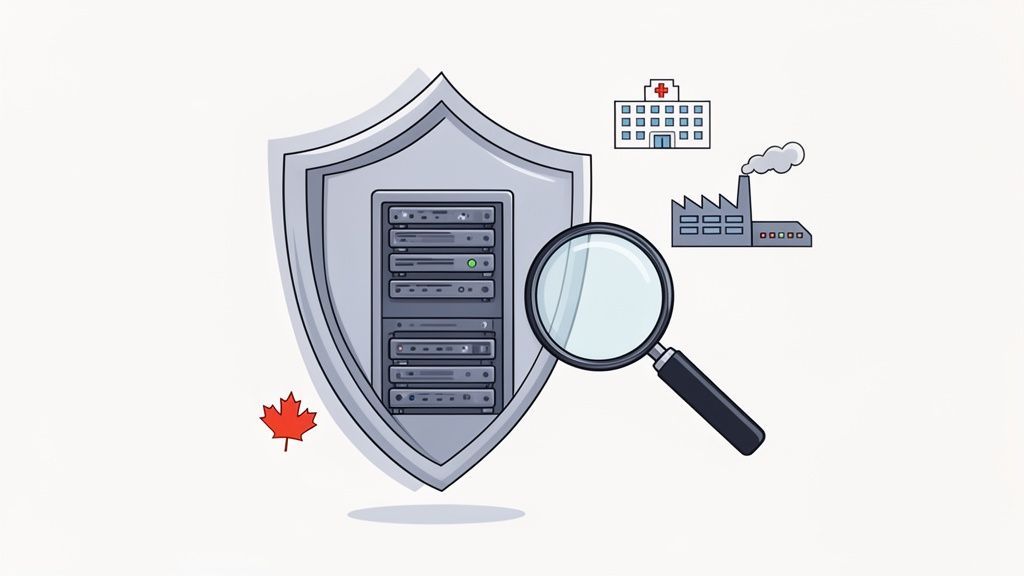
The threat landscape in Canada is escalating quickly. According to recent reports, cyber attacks on Canadian businesses have surged, with the manufacturing and healthcare sectors being prime targets.
Here in Ontario, the numbers are equally stark. A significant percentage of medium-sized organizations in logistics and finance have experienced at least one breach, with the average incident costing well over a hundred thousand dollars. These are not just statistics; they represent real businesses facing real, and often devastating, consequences.
Not long ago, a simple antivirus program might have been sufficient protection. Today, relying on that same software is like trying to stop a freight train with a bicycle lock. Modern cyber threats are sophisticated, relentless, and designed to bypass outdated defences.
This means you need an IT partner who offers more than a reactive solution. They need to be actively hunting for threats inside your network, not just waiting for an alarm to go off.
A strong security posture is built on layers. It is not about a single tool; it is about a cohesive ecosystem of proactive defence, rapid response, and continuous improvement. Your IT consultant should be able to clearly explain how their services work together to create this shield.
Look for a consultant who can provide these key services:
When interviewing a potential consultant, ask them to walk you through their security stack in plain English. What is their process for handling a suspected breach? How would they manage vulnerabilities in a high-stakes environment like a manufacturing plant, where any downtime means a major loss?
Their answers will reveal everything you need to know about their real-world capabilities.
For businesses aiming to build a solid security foundation, it helps to review practical guides like these Cybersecurity Tips For Small Businesses. At CloudOrbis, we offer a full suite of advanced cybersecurity services designed to protect Canadian businesses from modern threats, so you can focus on growth with complete peace of mind.
A true IT partnership extends far beyond fixing what is broken. It is about finding ways for technology to fuel tangible business growth. When you search for "IT consulting near me," you are really looking for a partner who can provide strategic direction. This is where sophisticated cloud expertise and Virtual CIO (vCIO) services make all the difference.

The cloud is not just a digital filing cabinet. When managed correctly, it is a powerful engine for making your business more efficient and scalable. However, simply moving your operations to the cloud is not the finish line. A true cloud expert helps you refine your setup to extract maximum value from your investment.
Many Canadian businesses are already on the cloud, but very few use it to its full potential. A 2026 IDC Canada report shows that cloud adoption among mid-sized firms surged by 52% from 2024, now at 78% penetration. In Ontario, that figure climbs to 82%, largely driven by optimizations within Microsoft 365 and Dynamics 365. The trend is clear: success isn't just about being in the cloud, it's about mastering it.
A skilled cloud consultant will dig deep into your environment to focus on:
We have seen the results firsthand. For oil and gas companies in Alberta, we have helped implement co-managed cloud setups that have cut infrastructure costs by 28%. In Ontario, we have worked with healthcare organizations to slash their data recovery times from days down to a matter of hours.
While a cloud expert perfects your technical infrastructure, a Virtual Chief Information Officer (vCIO) aligns all that technology with your long-term business goals. A vCIO is not there for day-to-day tickets; they are your high-level tech advisor.
Your vCIO is not just another consultant; they are a key member of your leadership team. Their role is to ensure that every dollar you invest in technology drives a measurable business outcome, from increased revenue to an improved market position.
This strategic direction is what separates a basic IT provider from a genuine growth partner. Your vCIO will work with you to create a detailed technology roadmap, ensuring your IT investments keep you one step ahead of the competition. They help you anticipate future needs, budget effectively, and make smart decisions that support your most important goals. You can explore this role further by reading our article about virtual CIO services.
It's this powerful combination, expert cloud management and strategic vCIO oversight, that transforms your IT from a simple operational cost into a core driver of your company's success.
You have done the heavy lifting, vetting local IT firms and narrowing down your options. Now comes the final, crucial step: choosing a partner and ensuring the handover is seamless.
This decision is about more than just a service contract; it is about forging a partnership. A smooth transition is not a matter of luck. It is the first real test of your new provider’s competence and is always backed by a clear, well-documented plan.
Before you sign on the dotted line, it is time to move beyond the sales pitch. The answers to these final questions will show you exactly how a firm operates and what you can expect as their client.
Here are a few critical questions to ask your top contenders:
These questions force a shift from what they do to how they do it. That is where you will find the real indicators of trust and transparency.
A best-in-class onboarding experience is a clear sign of a mature IT partner. It should be a documented, multi-step process designed to minimize disruption, from initial network discovery to comprehensive employee training.
A professional IT partner will not just offer vague promises; they will present a detailed transition plan. This document is your roadmap, outlining exactly how they will take control of your IT environment with precision and care.
A strong onboarding framework is one of the most reliable indicators of a good provider. This is why vCIO services are becoming so popular, with 68% of mid-sized businesses now using them to ensure IT aligns with business goals right from the start.
A 2025 poll from the Canadian IT Association found that 91% of clients praised providers who used structured frameworks, citing minimal business disruption as the top benefit. These methodical, data-driven processes, which you can learn more about by exploring the findings on business goal alignment, ensure nothing is missed.
At CloudOrbis, our own 10-step process was built on this principle. A methodical approach sets the stage for a stable, predictable, and successful long-term partnership.
When you begin looking for an IT partner, some common questions always arise. We hear them frequently from business leaders who are ready to make a change but need clarity before they commit.
Let's address a few of the most common ones.
This is often the first question asked, and for good reason. While there is no one-size-fits-all price, costs for a medium-sized business are typically structured as a monthly fee per user or device, often ranging from $100 to over $250 per user.
But the monthly fee is only half the story. The real focus should be on the return on investment (ROI).
A cheaper plan might look appealing, but if it omits proactive monitoring or robust cybersecurity, you are left vulnerable. The resulting downtime or a data breach will cost far more than you saved. A true partner justifies their price with better efficiency, hardened security, and strategic advice that fuels your growth.
If you are trying to compare options, looking into dedicated IT Consultation services can help you understand what different pricing models include.
A smooth, disruption-free transition is non-negotiable. Realistically, you should expect the entire process to take anywhere from 30 to 90 days. The timeline depends on the complexity of your current setup, but any professional firm will have a structured onboarding plan to make it seamless.
A well-managed transition should be nearly invisible to your team. The goal is a seamless handover that maintains business continuity, with your new partner handling all the technical heavy lifting behind the scenes.
This process is carefully managed and typically involves:
Absolutely, and it is the model we champion. Modern local IT firms give you the best of both worlds. We use sophisticated remote monitoring and management (RMM) tools to provide continuous 24/7/365 oversight of your entire system.
This powerful remote capability is always backed by the promise of a local presence. If a problem arises that cannot be fixed from afar, you have a team of experts right in your community, ready to be on-site to resolve it quickly and effectively.
Ready to partner with a local IT expert who understands your business needs? At CloudOrbis Inc., we provide the proactive support, strategic guidance, and robust security your business needs to thrive. Book your free consultation today!
Book a 30-minute call with a senior engineer. No sales script, just straight answers about your environment.


