Guide to Choosing IT Consultants in Vancouver for Your Business Growth
Find the right it consultants vancouver to boost performance. Practical steps to assess capabilities, compare options, and secure a value-driven partner.

Find the right it consultants vancouver to boost performance. Practical steps to assess capabilities, compare options, and secure a value-driven partner.

Choosing the right IT consultants in Vancouver is not just about finding technical support, it is about securing a strategic partner who understands the city’s competitive landscape. For any medium-sized organization here, particularly in sectors like healthcare, logistics, or manufacturing, this relationship is a critical investment in your growth, security, and resilience.
In Vancouver's fast-paced economy, outdated IT is more than an inconvenience; it is a genuine barrier to growth. Many businesses are moving away from the old, reactive "break-fix" model where you only call for help when something is already broken. That approach simply no longer works.
Instead, they are forming strategic partnerships with IT consultants to gain a real competitive advantage.

This is not just about outsourcing a few tasks; it is an investment in future-proofing your operations. The right partner helps you navigate complex cybersecurity threats, cloud integrations, and confusing regulations, freeing up your leadership team to focus on what they do best: running the business.
One of the biggest challenges for Vancouver businesses is the tight tech talent market. IT services growth in Western Canada is outpacing the rest of the country, creating a major skills gap.
Here in British Columbia, the labour market is so strained that salary growth is forecasted at 3.60% annually. This makes attracting and, more importantly, retaining specialized experts a serious challenge.
It’s especially tough for senior roles. The unemployment rate for a cloud architect, for example, is a staggering 0.9%. That scarcity is felt acutely right here in Vancouver, making it nearly impossible for most small and medium-sized organizations (SMEs) to build a complete in-house team.
Partnering with an IT consulting firm gives you immediate access to a deep bench of specialists, from cybersecurity analysts to cloud engineers, without the crippling cost and effort of trying to recruit them yourself.
The real difference between a basic IT provider and a true strategic partner comes down to their approach. A reactive provider waits for your call when something breaks. A proactive consultant works to prevent things from breaking in the first place.
That proactive mindset is what builds business resilience.
A strategic partner brings much more to the table:
For a massive project like a data centre migration, a partner can provide the expert guidance and a detailed data center migration checklist to ensure it gets done right. This level of support is just one of the many benefits of managed IT services that help your business run more securely and efficiently.
Jumping into the search for an IT consultant in Vancouver without a clear plan is a recipe for wasted time and a poor fit. Before you look at potential firms, you need to look inward. This self-assessment is the single most important part of the entire process.
Think of it this way: you would not ask a contractor to build a house without giving them blueprints. In the same way, you cannot expect an IT firm to deliver what you need if you have not mapped out your organization's tech challenges, goals, and obligations first.
Let's start with what is impacting your business right now. Where do you feel the most friction in your day-to-day operations? These pain points are usually the most pressing reason for bringing in outside help.
Are any of these familiar?
Writing these issues down gives you a concrete list of problems for a consultant to solve. It changes the conversation from a vague "we need IT help" to a specific, "we need to fix these five things."
A clear list of your current IT challenges is your greatest asset in early conversations. It helps you instantly disqualify any firm that does not have direct experience solving the exact problems you are facing.
Fixing today's problems is one thing, but a real strategic partner should help you build for tomorrow. Your technology needs to do more than just keep the lights on, it must power your future growth.
Ask yourself where you see the business in the next three to five years.
For instance, a logistics company planning to open a second warehouse needs an IT infrastructure that can scale without a hitch. An accounting firm looking to offer new client services might need a more secure and robust cloud platform. Tying your IT needs to these business goals is critical for finding a partner who can provide forward-thinking IT strategy and consulting.
For many Vancouver businesses, compliance is not just a good idea, it is the law. Your industry determines which regulations you must follow, and getting it wrong can lead to crippling fines and a damaged reputation. Before speaking with any IT consultant, it is vital to perform a thorough needs analysis. You can learn more about how to do this effectively in A Practical Guide to Your Next Assessment of Needs.
Your assessment needs to include a checklist of every regulation that applies to you, such as:
Any potential IT partner must have proven, hands-on experience with the specific compliance frameworks that govern your industry. This is not an area where you can afford to let someone learn on the job.
By creating this detailed blueprint first, you empower yourself to ask the right questions and ensure every conversation with potential IT consultants in Vancouver is productive from the start.
Now that you have mapped out what you need from an IT partner, the next step is sorting through the options to find the right one in a crowded Vancouver market. This is where you must look past slick websites and sales pitches to find a firm that genuinely understands your business. The goal is to separate the true strategic partners from the reactive, break-fix shops.
Vancouver's IT scene is booming. The Canadian market is projected to hit $114.0 billion by 2025, with massive demand for cloud, AI, and cybersecurity. We see this firsthand in Vancouver, as local industries like manufacturing, logistics, and healthcare race to modernize. But with over 111,000 consulting firms across Canada, finding an established player with a proven local track record is key. You can dig into the numbers yourself by checking out the full industry report on IT consulting in Canada.
You will find plenty of firms that claim they can "do it all." Your job is to find the one that specializes in your world. A consultant who knows the specific compliance challenges of a Vancouver legal practice or the logistical pressures of a Richmond distribution centre is more valuable than a generalist.
Start by digging into their case studies and client list.
Having a clear definition of your own needs is the foundation for this evaluation. It gives you a scorecard to measure every potential partner against.
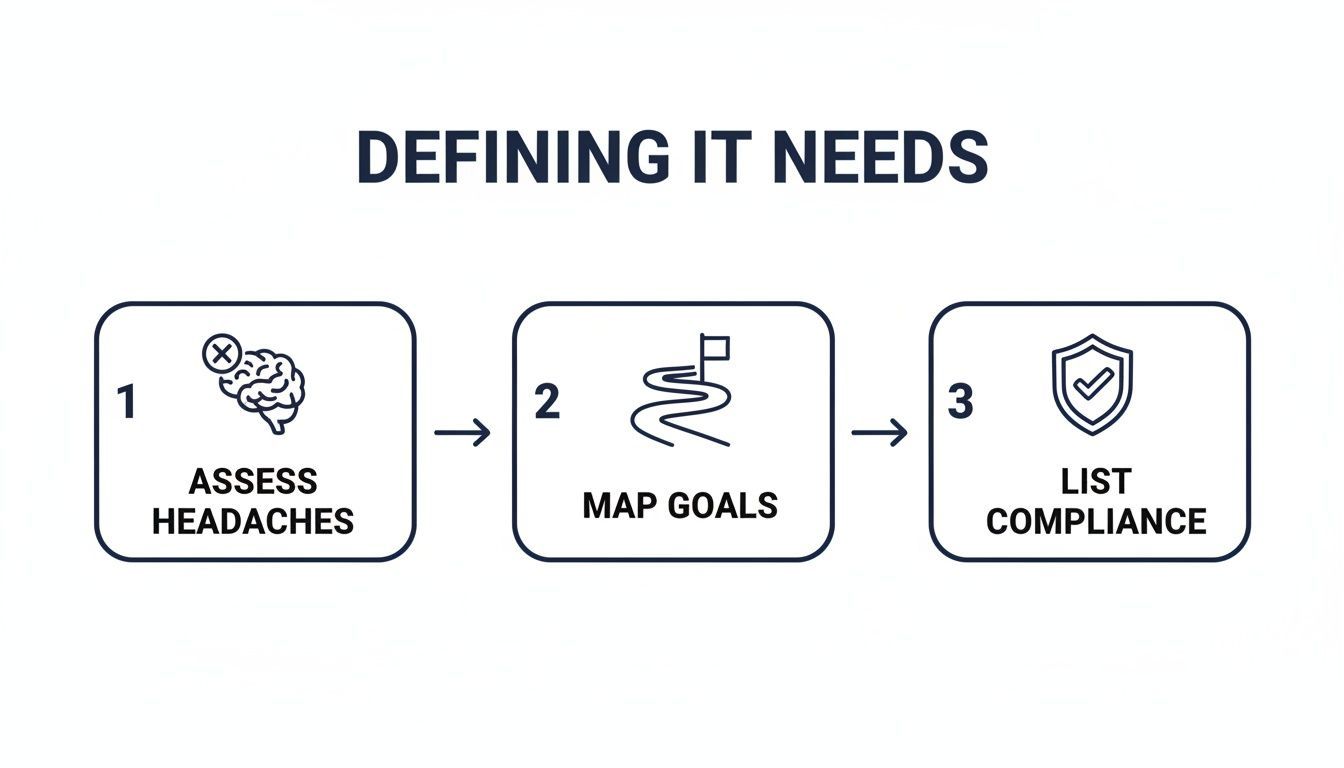
When you know exactly what you are looking for, it is much easier to spot a provider whose experience directly matches your challenges.
Not all IT support is created equal. The biggest difference you will encounter is between a reactive provider and a proactive partner, and it completely changes the relationship.
A reactive firm is like a fire department, they only show up when something is already on fire. Their business often revolves around billing for emergency hours, which means they profit when you have problems.
On the other hand, a proactive partner is more like an architect. They focus on building a resilient and secure IT foundation to prevent fires from starting in the first place. Their success is tied to minimizing your downtime and risk.
This proactive approach is often delivered through a Virtual Chief Information Officer (vCIO) service. A vCIO gives you the high-level strategy you need, helping you build a long-term technology roadmap that supports your business goals. It is what turns IT from a necessary expense into a real driver for growth. This is a critical differentiator to look for when choosing an it outsourcing company to support your business here in Vancouver.
Finally, you need to get into the nuts and bolts of how they operate. A great-looking website means nothing if the team and tools behind it are weak.
Here are the key areas to investigate:
By digging into these three areas, their industry focus, their service model, and their technical depth, you will be able to confidently narrow down your list to the IT consultants in Vancouver who can be a true strategic asset for your business.
Once you have narrowed down your list of potential IT consultants in Vancouver, the interview is where the real evaluation begins. This is your chance to get past slick marketing brochures and see how a firm actually thinks and operates under pressure.
To do this, you need to ask questions that pull back the curtain on their processes, problem-solving philosophy, and real-world expertise. Generic questions will only get you rehearsed, generic answers. Asking "What are your services?" is just an invitation for a sales pitch. Instead, frame your questions around situations your business could genuinely face.
Your goal here is to get them telling stories. The best consultants can draw on a deep well of experience, and their answers will give you a clear picture of both their technical skill and how they manage client relationships.
Try asking questions like these:
These kinds of questions force them to think on their feet and move beyond theory. A confident, detailed response is a great sign of genuine experience. These principles hold true no matter which Canadian city you are in; we cover similar ground in our guide to hiring an IT consultant in Toronto.
Knowing what to look for is just as important as knowing what to ask. Some warning signs are obvious, but others are more subtle and only appear if you are paying close attention.
One of the first things to probe is their service model. Today, the Canadian IT market is dominated by proactive services, which are set to generate the largest revenue share by 2025. This is especially true here in Vancouver, where manufacturing firms use cloud monitoring to stay ahead and healthcare providers need advanced threat detection to secure patient data. A consultant who cannot explain their proactive strategy is already falling behind. You can read the full research on Canada's IT services market for more detail on this trend.
As you review their proposals and conduct interviews, keep a sharp eye out for other common red flags.
Some of the most telling warning signs appear right in the proposal document. Here is what to watch for.
| Red Flag | Why It's a Concern | What to Look for Instead |
|---|---|---|
| Vague or Opaque Pricing | If they cannot clearly explain what is included in their fees, you are walking straight into surprise costs and budget overruns. | A detailed, itemized proposal that breaks down all services, software licences, and any potential extra project charges. |
| A "One-Size-Fits-All" Approach | Your business is not generic, and your IT solutions should not be either. A firm pushing a standard package without a deep discovery process does not value your specific needs. | A consultant who asks probing questions about your operations and proposes a solution that directly solves your stated problems. |
| No Local Vancouver References | A lack of verifiable, local clients could mean they are new to the area or do not have a strong track record within the Vancouver business community. | A list of local client references in similar industries that you can actually call to verify their experience and service quality. |
A great proposal should feel like it was written specifically for you, because it was. Anything less is a signal that they might not be the dedicated partner you need.
A consultant's inability to present a clear, proactive strategy for your security and growth is perhaps the biggest red flag of all. It signals they are a reactive "break-fix" shop, not a true strategic partner.
Ultimately, the interview process is about building confidence. You are looking for a partner who is transparent, brings deep expertise relevant to your industry, and shows a genuine interest in helping you succeed long-term. By asking insightful questions and watching for these red flags, you can confidently choose from the best IT consultants Vancouver has to offer and secure a partner who will be a true asset for years to come.
You have signed the contract. That is a huge step, but the real work, and the real value, begins now. A great partnership with your chosen IT consultants in Vancouver is built on two things: a seamless onboarding process and a clear way to measure success. This is where your investment truly starts to pay off.
The first few months set the tone for the entire relationship. A top-tier firm will not just take over; they will guide you through a methodical transition, embedding themselves into your operations with minimal disruption until they feel like an extension of your own team.

This initial phase is all about total immersion. Your new partner should be laser-focused on learning everything they can about your business and your technology. This is not just a box-ticking exercise; it is a deep discovery mission that creates the foundation for every strategic decision to come.
During this period, you should expect to see a few key activities:
Think of it this way: your new partner is essentially creating a detailed map of your entire IT world. The better the map, the faster they can navigate it to solve problems and guide you toward your goals.
A new IT partner brings new processes. One of the most common stumbling blocks is overlooking the need to train your staff on how to work with the new provider. People naturally resist change, so making the new way easy and obvious is key to getting everyone on board.
A good IT firm will take the lead here. They should provide clear documentation, quick-start guides, and perhaps even host a short training session. When your employees feel confident and know exactly who to call and what to expect, they are far less likely to revert to old, inefficient habits. You can also find more tips on building a productive relationship by reading our article on how to get more out of your IT provider.
To know if your new partnership is truly delivering value, you have to track more than just a gut feeling. You need concrete metrics, Key Performance Indicators (KPIs), that are tied directly to your business goals. Forget vanity metrics like the number of tickets closed. Focus on results that actually impact your bottom line.
A strong partnership is built on accountability and tangible results. By establishing clear KPIs from the outset, you turn your IT relationship into a strategic investment focused on continuous improvement and measurable business value.
Here are a few powerful KPIs we always recommend tracking:
By focusing on these business-centric metrics, you ensure that your IT consultants in Vancouver are not just fixing what is broken, they are actively driving your organization's success. This data-driven approach builds a relationship grounded in transparency, accountability, and shared goals.
Choosing the right IT support is one of the most critical business decisions you will make. This is not just about hiring someone to fix what is broken; it is about finding a strategic partner who truly understands the unique pressures and opportunities of the Vancouver market.
As we have covered, this process starts with a hard look at your own needs, followed by a careful evaluation of potential partners, and a clear plan to measure success. Making the right choice empowers you to move beyond reactive fixes and start building a resilient, secure, and future-ready business.
A true partner offers proactive guidance, aligning your technology with your most important business goals. They should bring proven experience in key Vancouver sectors like logistics and healthcare, offering the specialized knowledge needed to navigate complex compliance and security challenges. This is the difference between an IT provider and a genuine strategic asset.
At CloudOrbis, we specialize in becoming that asset for medium-sized organizations. Our 100% Canada-based 24/7 helpdesk, proactive security focus, and deep experience with businesses just like yours mean we are ready to deliver the reliable, strategic support you need to grow.
Choosing your IT consultant is a long-term investment in your company’s future. It is about securing a partner who is just as committed to your success as you are.
We believe that enterprise-grade IT should be accessible, not intimidating. We partner with Vancouver businesses to replace outdated systems with modern, secure, and efficient solutions so leaders can focus on growth with complete confidence.
Ready to see how the right IT consultants in Vancouver can make a real difference? Contact CloudOrbis today for a no-obligation assessment. Let's discuss your specific IT challenges and create a strategic roadmap to help you achieve your business goals.
When you are thinking about bringing on an IT partner, many questions come up. It is a big decision, and we understand that. Here are some of the most common questions we hear from Vancouver business leaders, with our straight-to-the-point answers.
The cost for IT consultants in Vancouver really depends on the service model. For a small, one-off project, you will likely pay by the hour. This can get expensive fast, especially if you need ongoing help.
For most businesses, a monthly managed services plan delivers far better value. These plans are usually priced per user or device, which makes your IT budget predictable and gives you proactive support. It is a much smarter approach than paying high emergency rates every time a server goes down. When you are comparing quotes, look past the sticker price and consider the total value, things like 24/7 support, advanced security tools, and strategic vCIO advice are often included.
A standard onboarding can take anywhere from a few weeks to a couple of months. The timeline really hinges on the complexity of your current IT setup, the size of your team, and the specific services you need.
Any good firm will walk you through a structured, multi-stage process. This should always include a deep initial assessment, strategic planning, full system documentation, and a phased rollout designed to cause as little disruption to your business as possible.
A rushed onboarding is a huge red flag. A proper transition takes time because your new partner needs to truly understand your systems, find security gaps, and learn your business workflows to provide support that actually works.
Absolutely. In fact, this is one of the most effective ways to structure your IT. It is a model called co-managed IT, and it is becoming incredibly popular for good reason. It creates a powerful partnership where your internal staff handles the day-to-day tickets and immediate user needs.
Meanwhile, the consulting firm brings in specialized expertise. This collaboration gives your team access to specialists in areas like cybersecurity or cloud architecture, plus enterprise-grade tools and 24/7 monitoring that would be too expensive to purchase on your own. It also fills strategic gaps with vCIO services, letting your in-house team focus on projects that move the business forward. It is the perfect way to scale your IT capabilities without adding headcount.
At CloudOrbis, we partner with Vancouver businesses to provide the strategic, proactive IT support you need to thrive. If you are ready to move beyond reactive fixes and build a secure, resilient technology foundation, we can help. Contact us today to learn more about how our managed IT services can support your growth. Find out more at https://www.cloudorbis.com.
Book a 30-minute call with a senior engineer. No sales script, just straight answers about your environment.


